The Vegetable Detectives: Inside the Race to Rescue America's Lost Heirloom Crops
Photo: liz west from Boxborough, MA, CC BY 2.0, via Wikimedia Commons
Somewhere in a seed library in Tucson, there are envelopes of Tohono O'odham tepary beans that haven't been grown commercially in decades. In a research plot in Montana, Painted Mountain corn—a variety so visually stunning it looks like something from a dream—is being carefully multiplied for a new generation of farmers. And in a barn in Vermont, a retired schoolteacher named Howard Kettleworth is nurturing seeds from a turnip variety that hasn't appeared in any catalog since 1923.
This is the world of heirloom vegetable rescue, and it is stranger, more urgent, and more hopeful than most people realize.
What We Lost, and How Fast We Lost It
The numbers are sobering. According to research from the Rural Advancement Foundation International, the United States lost an estimated 93 percent of its food crop varieties over the course of the twentieth century. In 1903, American seed houses offered over 500 distinct varieties of cabbage. By 1983, that number had collapsed to around 28.
The culprit wasn't malice. It was efficiency. Industrial agriculture selected for varieties that could be mechanically harvested, shipped long distances, and stored for weeks without spoiling. Flavor, nutritional density, and genetic diversity were, at best, secondary concerns. What survived wasn't necessarily the best—it was the most commercially convenient.
"We essentially narrowed the genetic library of our food supply down to a handful of chapters," says Dr. Alicia Moreno, an ethnobotanist at the University of New Mexico. "And when you do that, you create fragility. A system with no diversity has no backup plan."
The Hunters
The people working to reverse this trend don't fit a single mold. Some are professional plant breeders at land-grant universities. Some are indigenous seed keepers protecting varieties that have been in their communities for centuries. Some are backyard obsessives who started collecting out of curiosity and ended up with walk-in freezers full of seed packets.
Kent Whealy co-founded the Seed Savers Exchange in Decorah, Iowa back in 1975, and the organization remains one of the most important repositories of heirloom vegetable genetics in the world—housing over 20,000 rare varieties. But the Exchange is just one node in a much broader, informal network.
In Montana, farmer Dave Christensen spent decades developing Painted Mountain corn, a cold-hardy, nutritionally dense open-pollinated variety bred specifically for short-season climates. What started as a personal project in the 1970s is now grown across the northern Great Plains and has attracted serious interest from nutritional researchers for its unusually high protein and antioxidant content.
"Dave essentially did what indigenous plant breeders had been doing for thousands of years," says seed librarian Tamara Okonkwo of the Rocky Mountain Seed Alliance. "He observed, selected, and adapted. The result is a variety that's genuinely suited to its place."
The Delicata Squash Story
Few heirloom rescues have played out as publicly—or as deliciously—as the revival of Delicata squash. Originally developed in the late 1800s and popular through the early twentieth century, Delicata essentially vanished from commercial production for decades. It was too delicate (the name is apt) for industrial handling, and its thin skin made long-distance shipping a gamble.
But small-scale farmers and seed savers kept it alive in private collections, and by the early 2000s, it had found its way back to farmers' markets and restaurant menus. Today, Delicata is one of the most sought-after fall squash varieties in the country—beloved by chefs for its sweet, nutty flavor and by home cooks for the fact that you don't have to peel it.
The Delicata story is instructive because it shows how market demand and preservation work can feed each other. Chefs who wanted something more interesting than butternut squash started asking farmers for unusual varieties. Farmers who grew them could charge a premium. And suddenly, keeping obscure heirloom seeds alive had an economic argument behind it, not just a philosophical one.
Why Biodiversity Is a Practical Issue, Not Just a Romantic One
It's easy to frame heirloom preservation as nostalgia—old farmers chasing the taste of their grandmothers' gardens. And there's nothing wrong with that motivation. But the deeper argument for genetic diversity in our food crops is coldly practical.
Monocultures are vulnerable. When a single pathogen or climate shift hits a genetically uniform crop, the damage can be catastrophic. The Irish Potato Famine is the most cited historical example, but the twentieth century offered plenty of others: the Southern Corn Leaf Blight of 1970, which destroyed roughly 15 percent of the entire U.S. corn crop in a single season, was directly linked to genetic uniformity in commercial hybrid varieties.
Heirloom and open-pollinated varieties, by contrast, contain far more genetic variation. Some individuals in a population may carry resistance to a disease that others don't. That variation is the raw material that plant breeders—and nature—need to adapt to changing conditions.
"Climate change is the thing that keeps me up at night," says Moreno. "We're going to need crops that can handle heat stress, drought, flooding, new pests. The genetic toolkit for developing those crops exists in diversity. And we're racing against the clock to preserve it."
The Market Is Catching Up
For years, heirloom varieties lived almost exclusively in the farmers' market world—beloved by a relatively small slice of food-conscious consumers willing to pay a premium for flavor and story. That's still true, but the audience is growing.
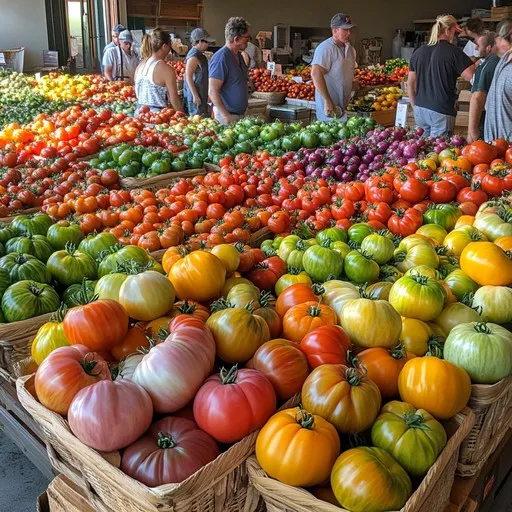
Restaurant chefs have been the most visible drivers of demand. A menu that lists "Jimmy Nardello peppers" or "Dragon Tongue beans" or "Cherokee Purple tomatoes" signals something to diners: this food came from somewhere specific, someone grew it with intention, and it's going to taste different from what you'd find at a chain grocery store. That differentiation has real commercial value.
Larger grocery retailers are also starting to pay attention. Specialty chains like Whole Foods and regional co-ops have expanded their heirloom offerings significantly over the past decade, and some conventional supermarkets are beginning to follow.
"The market for food with a story is real and it's growing," says Okonkwo. "People want to know where their food comes from. Heirloom varieties give you exactly that—a name, a history, a place. That's not nothing."
What You Can Do
You don't have to be a professional seed saver to participate in this work. Buying heirloom varieties at farmers' markets directly supports the farmers growing them. Donating to organizations like Seed Savers Exchange, Native Seeds/SEARCH, or the Rocky Mountain Seed Alliance helps fund preservation efforts. And if you have a garden—even a small one—growing open-pollinated varieties and saving seeds is one of the most direct contributions any individual can make.
The vegetables that nearly disappeared didn't vanish because nobody loved them. They disappeared because a food system optimized for scale and profit had no room for them. Bringing them back is, in a very real sense, an act of resistance—and one that happens to produce extraordinarily good food.