The Crooked Carrot Comeback: How Imperfect Produce Became the Hottest Thing at the Farmers' Market
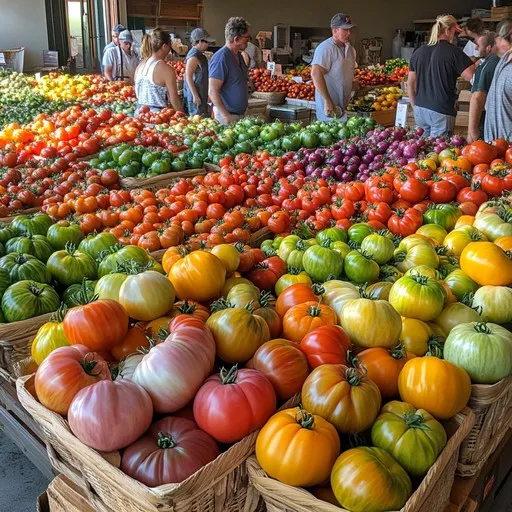
Photo: imperfect vegetables colorful misshapen tomatoes carrots farmers market display, via images.stockcake.com
Nobody Told the Carrot It Was Ugly
Let's start with a confession: the American supermarket has been lying to you about vegetables your entire life.
That perfectly cylindrical orange carrot, uniform in diameter from tip to top? It was selected, sorted, and in many cases mechanically shaped to meet cosmetic standards that have nothing — absolutely nothing — to do with flavor, nutrition, or the actual experience of eating a carrot. Meanwhile, its twisted, forked, gloriously weird sibling got tossed into the reject pile, destined for animal feed, composting, or the landfill.
But something is shifting on American farms, and it smells like fresh dirt and good business sense.
The Numbers Behind the Waste
Before we get into the comeback story, let's sit with the scale of the problem for a second, because it's genuinely jaw-dropping.
Roughly 20 billion pounds of produce goes unharvested or unsold in the United States every year, according to the USDA. A significant portion of that waste isn't due to spoilage, disease, or pest damage — it's purely cosmetic. Retailers and distributors impose strict grade standards for size, shape, color, and surface appearance, meaning that a perfectly nutritious, perfectly delicious vegetable gets rejected simply because it grew in an unexpected direction or developed a superficial blemish.
For farmers, this is more than an aesthetic inconvenience. Those rejected "seconds" represent real input costs — seeds, water, labor, fuel — with zero return. On tight margins, that's the difference between a profitable season and a brutal one.
"I was throwing away maybe 30% of my crop every year just because it didn't look right," says Tomás Rivera, who runs a 15-acre diversified vegetable operation outside of Fresno, California. "Good food. Tasty food. Just not pretty food. It felt criminal."
So Rivera did what a growing number of American farmers are doing: he stopped apologizing for it and started selling it.
Rebranding the Reject
The word "ugly" is doing a lot of heavy lifting in this conversation, and honestly, it might be time to retire it. Farmers and food marketers who have found success with imperfect produce tend to lean into language that reframes the whole concept — words like "heirloom," "authentic," "field-run," "character," and "honest" show up again and again.
At his booth at the Fresno Farmers' Market, Rivera now displays his irregular produce under a hand-painted sign that reads "Real Vegetables, Grown Real." He sells his misshapen bell peppers in mixed bags labeled "Flavor Pack" — no mention of imperfection, just an emphasis on variety and freshness. They sell out by 10 a.m. most Saturdays.
"People love a story," Rivera says. "When I explain that these are the same peppers the grocery store won't take because of how they look, customers feel like they're in on something. Like they found the secret."
That psychological dynamic — the appeal of the insider deal, the satisfaction of rejecting superficial standards — turns out to be a powerful sales driver. Research from the Cornell Food and Brand Lab has found that consumers who understand why produce looks different are significantly more willing to purchase it, and often perceive it as more authentic and farm-fresh than its picture-perfect counterparts.
The Economics of the Wonky Vegetable
Here's where it gets genuinely interesting from a business perspective: imperfect produce isn't just reducing waste. In many cases, it's generating premium revenue.
Direct-to-consumer channels — farmers' markets, CSA (community-supported agriculture) subscriptions, farm stands, and online delivery boxes — have become the primary venue for imperfect produce sales, and the economics work very differently than wholesale. When you cut out the distributor and the retailer, margins expand dramatically. A tomato that would have been rejected by a grocery chain for being too lumpy can be sold at a farmers' market for the same price — or more — than a conventionally graded one.
Subscription box companies have built entire business models around this concept. Misfits Market and Imperfect Foods, both of which operate nationally, have raised hundreds of millions in venture capital on the premise that consumers will pay for convenient delivery of cosmetically imperfect produce at a discount to grocery store prices. But smaller, farm-direct operations are finding that they can actually charge a premium when the imperfect produce narrative is told well.
Elena Marchetti runs a small organic farm in the Hudson Valley of New York and started offering a "Seconds Share" add-on to her CSA last season — a box of cosmetically imperfect produce priced at a slight discount to her regular shares. She expected modest uptake. Instead, the Seconds Share waitlist is now longer than her regular CSA waitlist.
"I think people are genuinely tired of the fake perfection," Marchetti says. "There's something almost aspirational now about buying the weird-looking tomato. It signals that you know what real food looks like."
The Environmental Argument Is Hard to Ignore
Beyond the dollars-and-cents conversation, the environmental case for embracing imperfect produce is compelling enough to make any sustainability-minded eater pay attention.
Food waste is one of the largest contributors to greenhouse gas emissions in the United States. When organic matter ends up in landfills rather than being eaten or composted, it decomposes anaerobically, releasing methane — a greenhouse gas roughly 80 times more potent than carbon dioxide over a 20-year period. The EPA estimates that food is the single largest category of material sent to landfills.
When farmers find markets for their cosmetically imperfect harvest, they're not just improving their bottom line — they're keeping food in the food system where it belongs, reducing the environmental footprint of agriculture, and honoring the land, water, and labor that went into growing it.
At Harvest Bloom, that last point feels especially significant. From field to table, every vegetable represents a season's worth of care — soil preparation, planting, watering, weeding, harvesting. Letting a perfectly edible carrot rot because it has two legs instead of one isn't just wasteful. It's a failure to respect the whole story of how food gets grown.
What You Can Do This Season
You don't need a CSA subscription or a specialty delivery service to participate in this shift. The simplest entry point is your local farmers' market. Ask vendors directly if they have any "field-run" or imperfect produce available — many farmers set these items aside and are happy to sell them at a slight discount, especially later in the market day.
If you're a CSA member, let your farmer know you're open to receiving cosmetically imperfect items. That kind of direct feedback matters.
And if you're growing your own food? Celebrate the weird stuff. The forked parsnip, the cracked heirloom tomato, the squash that grew into an abstract sculpture — these are signs of a living, variable, real food system doing its thing.
The crooked carrot didn't need a rebrand. It just needed someone to finally tell the truth about it.