Breaking the Commodity Cycle: Meet the Farmers Reinventing American Agriculture One Field at a Time
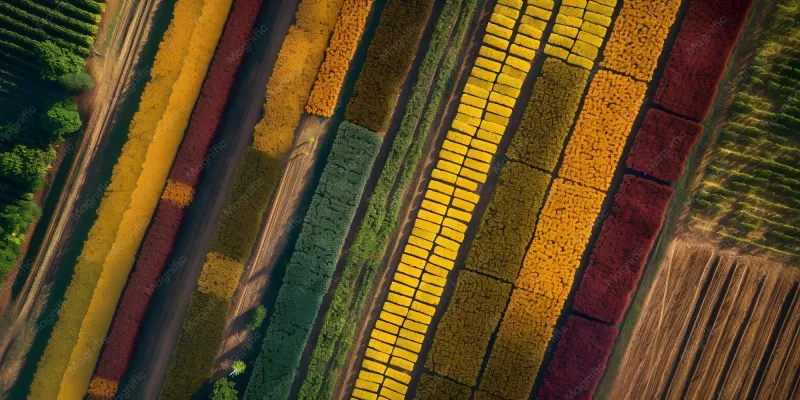
Photo: diverse small farm crops regenerative agriculture mixed vegetables and grains aerial view, via img.freepik.com
Drive through central Illinois in August and the view doesn't change for miles. Corn. Then more corn. Then soybeans. Then corn again. The fields are immaculate, the rows laser-straight, the landscape scrubbed of almost everything that isn't a commodity crop. It's impressive in a way that's also quietly unsettling — a vast, humming monoculture that feeds the world and, increasingly, struggles to sustain the people farming it.
The commodity treadmill, as farmers and agricultural economists have long called it, works like this: you grow one or two crops at scale, sell them into a global market you have zero control over, watch input costs rise faster than prices, and borrow to make up the difference. Repeat until retirement or bankruptcy, whichever comes first. For generations, American farm policy has been built around this model. And for a growing number of farmers — quietly, stubbornly, across very different regions and very different scales — it's a model they're choosing to leave behind.
A Missouri Row Cropper Discovers the Soil Beneath His Feet
Marcus Hale farmed 1,800 acres of corn and soybeans outside Kirksville, Missouri for nearly two decades before he started noticing something he couldn't ignore: his soil was getting worse. Compaction was increasing. Erosion was eating his topsoil. Input costs — fertilizer, herbicides, seed treatments — kept climbing, and the yields weren't climbing with them.
"I was spending more to get the same result," he says. "And I knew the land was telling me something."
Five years ago, Hale began transitioning portions of his operation to cover cropping and reduced tillage, eventually experimenting with integrating a small cattle herd to graze cover crops through winter — a practice sometimes called adaptive multi-paddock grazing. The shift wasn't cheap or easy. There was a learning curve measured in failed experiments and some genuinely discouraging seasons.
But the soil data he's collected tells a story he finds hard to argue with. Organic matter on his transitioned fields has climbed from 1.8% to nearly 3.2% over four years. Water infiltration has improved dramatically, which means less runoff and better drought resilience. He's cut his synthetic nitrogen application by roughly 30% on those fields without a corresponding yield loss.
"I'm not anti-commodity," he's careful to say. "I still grow corn and beans. But I'm growing them differently, and I'm growing other things too. The farm feels more alive than it did."
From Cotton to Complexity in the Texas Panhandle
The story looks different in the High Plains, where water scarcity has been forcing the issue in ways that no amount of idealism could accelerate on its own. Renata and Dwayne Ochoa farmed cotton and grain sorghum outside Lubbock for years, drawing heavily on the Ogallala Aquifer like most of their neighbors. When water table reports started showing the kind of decline that has hydrologists genuinely alarmed, they made a decision that raised eyebrows locally: they downsized their irrigated acreage significantly and began building a diversified dryland operation centered on drought-tolerant heritage grains, dry beans, and a small market garden operation supplying restaurants in Lubbock and Amarillo.
The economics are genuinely complicated. Commodity markets, for all their volatility, offer liquidity and infrastructure that diversified operations often lack. The Ochoas spent two years building direct relationships with chefs and distributors before the revenue felt stable. There were seasons where the math was frightening.
"Nobody tells you how hard the marketing part is," Renata says with a laugh that contains real exhaustion. "Growing the food is the part we knew how to do. Selling it at a price that made sense — that took years to figure out."
What they've built now — a farm that uses a fraction of the water their previous operation required and generates margins that actually reflect the true cost of production — has become something of an informal model for neighbors curious about alternatives. Not everyone is convinced. But the conversations are happening.
A Vermont Dairy Farmer's Pivot to Vegetables and Community
In the Northeast, the story of farm diversification often runs through the wreckage of the dairy industry. Elaine Fortier's family milked cows on 200 acres in Vermont's Northeast Kingdom for three generations before the math finally stopped working. When she took over the operation in her late thirties, she inherited both the land and the debt.
Rather than sell, she spent two years in conversations with neighboring farms, local food co-ops, and a regional hospital system that had expressed interest in sourcing more local produce. What emerged was a CSA and wholesale vegetable operation built on the farm's existing infrastructure, supplemented by a small pastured pork program that uses the farm's woodlot and marginal pasture land.
Fortier is quick to acknowledge the privileges that made her transition possible — land that was already paid down, a spouse with off-farm income during the riskiest transition years, and proximity to a consumer base that could pay fair prices for locally grown food. "I don't want to make it sound like anyone can just do what I did," she says. "The structural stuff matters. Access to land, access to markets, access to capital. Not everyone has those things."
That honesty matters, because the story of farm diversification in America runs directly into a wall of structural barriers that personal inspiration alone can't dismantle.
Why Most Farmers Haven't Made the Leap
It would be easy — and wrong — to frame this as a story about farmers who just need to think differently. The commodity system isn't just a mindset; it's a deeply entrenched infrastructure of policy, financing, and market access that actively makes diversification harder.
Farm bill subsidy programs have historically favored commodity crops. Crop insurance, which most farmers depend on to manage risk, is far more accessible and affordable for corn and soybeans than for specialty crops or mixed operations. USDA loan programs have often been calibrated for commodity-scale operations. And the processing and distribution infrastructure for diversified crops — the regional slaughterhouses, grain aggregators, and cold storage facilities that small and mid-sized farms need — has been gutted over decades of consolidation.
There's also the knowledge gap. Farmers who've grown corn their whole lives are not automatically equipped to manage the complexity of a diversified operation. Transition support, technical assistance, and peer learning networks exist but remain underfunded and inconsistently available.
"Policy is the accelerator," says one agricultural extension agent who works with transitioning farmers in the upper Midwest. "Right now the policy environment is like driving with one foot on the gas and one foot on the brake. You can make progress, but it costs you."
What Acceleration Could Actually Look Like
The farmers who've made this shift aren't waiting for policy to catch up — but they're also clear-eyed about what policy changes would matter most. More robust crop insurance for diversified operations. Expanded USDA support for regional food infrastructure. Technical assistance programs with real funding behind them. And farm bill reform that stops treating commodity monocultures as the default definition of American farming.
Some of this is moving, slowly. The 2023 investment in regional food systems through USDA programs was a meaningful step. Regenerative agriculture is attracting private investment from food companies trying to hit sustainability targets. And the farmers who've diversified are, increasingly, becoming the most compelling evangelists for change — not through ideology, but through the simple evidence of their soil tests, their balance sheets, and the fact that their farms are still standing.
The mosaic is growing. Field by field, season by season, one farmer at a time deciding that the treadmill isn't the only way forward. It's not fast enough. But it's real.