One Field, Many Crops: The Farmers Trading Monoculture for Living Mosaics
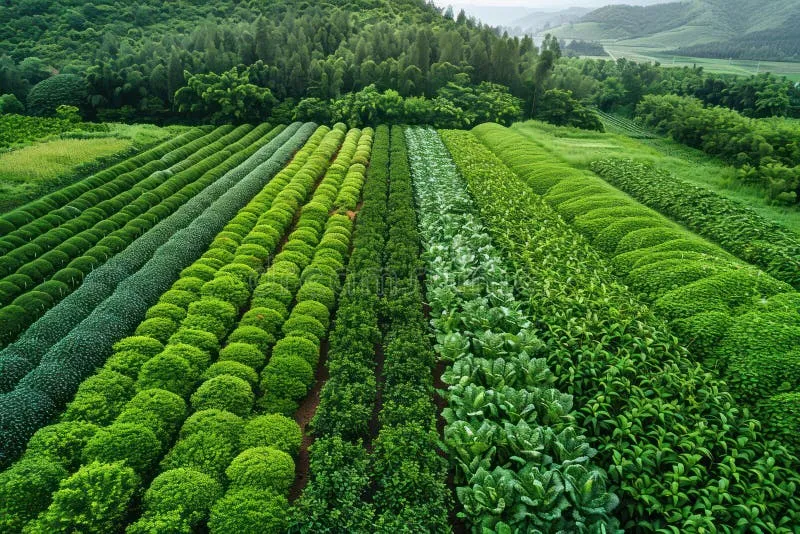
Photo: diverse polyculture farm field mixed crops growing together aerial view, via thumbs.dreamstime.com
Drive through the rural Midwest on any given summer day and you'll see it everywhere: mile after mile of a single crop, stretching to the horizon in perfect, unbroken rows. Corn. Then more corn. Then soybeans. Rinse and repeat. It's a landscape that's been normalized over decades of industrial agriculture, but for a growing number of American farmers, those vast green monocultures are starting to look less like efficiency and more like a slow-motion ecological mistake.
Enter polyculture — the practice of growing multiple crops together in the same space, often in deliberate combinations that mimic the layered complexity of a natural ecosystem. It's not a new idea. Indigenous farming traditions across North America practiced sophisticated multi-crop systems for centuries. But right now, polyculture is having a serious moment, showing up on small diversified farms, university research plots, and regenerative agriculture conferences from Vermont to California.
So what's driving the shift? And what does it actually look like when a farmer trades in their single-crop identity for something messier, wilder, and — according to the evidence — considerably more alive?
The Problem With Planting One Thing
Monoculture farming has a seductive logic to it. Specializing in one crop makes equipment purchases simpler, harvesting more efficient, and market relationships easier to manage. For decades, that logic dominated American agriculture, backed by government subsidies, commodity markets, and the promise of economies of scale.
But the cracks have been showing for a while. Single-crop systems strip soil of specific nutrients year after year, requiring ever-heavier applications of synthetic fertilizers to compensate. Without the biological diversity of mixed plantings, pests and diseases spread rapidly through uniform fields — which means more pesticide use, more resistance, more cost. And when one crop fails, whether from drought, flood, or a surprise fungal outbreak, the entire farm's income takes the hit.
"A monoculture field is basically a buffet for pests and a desert for everything else," says Marcus Webb, who farms about 200 acres outside Asheville, North Carolina. Webb spent 15 years growing tobacco before transitioning his land to a diversified polyculture system. "I was fighting the same problems every single season, spending more money each year to get the same results. Something had to change."
What Polyculture Actually Looks Like on the Ground
Polyculture isn't one thing — it's a spectrum of approaches, each tailored to a farm's specific geography, climate, and goals. On Webb's land, it means interplanting nitrogen-fixing cover crops like clover and vetch between rows of vegetables and small grains. The legumes feed the soil while the cash crops grow alongside them, reducing the need for purchased inputs and giving the land a chance to breathe.
Further west, at Sunroot Farm in the Willamette Valley of Oregon, farmer Dani Okafor takes the concept further with what she calls "guild planting" — grouping crops together based on their ecological relationships rather than their market categories. Tall sunflowers shade low-growing lettuces during summer heat. Deep-rooted daikon breaks up compacted subsoil while shallow-rooted herbs occupy the surface. Flowering herbs attract the beneficial insects that keep aphid populations in check.
"When I walk through the field, I'm not just looking at individual plants," Okafor explains. "I'm watching relationships. Who's feeding who? Who's protecting who? That's what makes a farm feel alive."
In Texas's Hill Country, rancher and farmer Eliot Garza is experimenting with what researchers call "agroforestry integration" — weaving fruit and nut trees into pasture and vegetable production. His cattle graze between pecan and persimmon trees, their manure feeding the soil that feeds the trees that drop shade and fruit back onto the same land. It's a closed loop that dramatically reduces his need for outside inputs.
"People think this looks chaotic," Garza says with a laugh, gesturing at a field that does, admittedly, look nothing like the tidy rows on neighboring properties. "But nature doesn't grow in rows. Once you stop trying to fight that, things get a lot easier."
The Soil Science Behind the Shift
The ecological case for polyculture isn't just intuitive — it's increasingly well-documented. Research from the Rodale Institute and several land-grant universities has consistently shown that diverse cropping systems build organic matter faster, support larger and more varied populations of soil microorganisms, and retain moisture more effectively than monocultures. Healthier soil microbiomes mean more nutrients become available to plants naturally, reducing dependence on synthetic fertilizers.
There's also a climate resilience argument that's hard to ignore. Diverse fields with varied root depths and canopy structures handle weather extremes better than uniform crops. When one species struggles in a dry stretch, others may thrive. When a late frost damages one planting, the rest of the mosaic carries on. Farmers operating polyculture systems consistently report that their yields are more stable year over year, even if peak years don't match the theoretical highs of a monoculture bumper crop.
For Marcus Webb, the difference in his soil after just three seasons of diversified planting was visible to the naked eye. "It went from this pale, sandy stuff that ran off in the rain to something dark and crumbly that actually holds water," he says. "My input costs dropped by about 30 percent in two years. That's real money."
The Market Question
Here's where polyculture gets complicated: selling variety is harder than selling volume. Commodity markets are built around single crops in massive quantities. A farmer growing 14 different vegetables, two grains, and a handful of herbs doesn't fit neatly into that system.
But that's also exactly where direct-to-consumer markets — farmers' markets, CSA subscriptions, farm-to-restaurant relationships — become a genuine economic lifeline. Polyculture farms tend to thrive in these channels because their diverse harvests are precisely what those customers are looking for. A CSA box from a polyculture farm in October might include sweet potatoes, winter squash, arugula, dried beans, and fresh herbs all at once — a spread that would be impossible from a monoculture operation.
Dani Okafor sells 90 percent of her harvest through a CSA and a handful of Portland restaurant accounts. "My customers aren't buying a commodity," she says. "They're buying into the whole ecosystem of this farm. The diversity is the product."
The Bigger Picture
Polyculture farming isn't a silver bullet, and scaling it up presents real challenges — more labor, more management complexity, more marketing hustle. It demands a different kind of farmer: one who thinks ecologically as much as economically, who's comfortable with a certain productive messiness, and who's willing to play a long game with their land.
But as climate pressures mount, input costs climb, and consumers increasingly demand to know where their food comes from and how it was grown, the monoculture model is looking more fragile by the season. The farmers building living mosaics in their fields aren't just chasing a trend. They're quietly rebuilding the agricultural commons, one diverse, tangled, gloriously complicated field at a time.
And if the soil under their feet is any indication, the land itself is pretty happy about it.